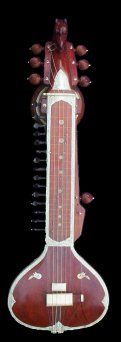
विचित्र वीणा और सितार की विशेषताओं का समन्वय
रंजन वीणा भारतीय तन्त्री-वाद्यों की आधुनिक परम्परा में विकसित एक विशिष्ट वाद्य है, जिसका निर्माण निरंजन हलदार ने किया है। इस वाद्य में विचित्र वीणा की वादन-तकनीक, सितार की स्वरात्मक विशेषताओं तथा गिटार-सदृश वादन-सुविधा को एक साथ लाने का प्रयास किया गया है। इसका उद्देश्य वादन को अपेक्षाकृत सरल बनाते हुए सितार के निकट ध्वनि-गुणवत्ता प्राप्त करना है।
रंजन वीणा की लम्बाई १०७० मिलीमीटर तथा चौड़ाई ३४५ मिलीमीटर है। इसमें पाँच मुख्य तन्त्रियाँ, दाहिनी ओर दो चिकारी तन्त्रियाँ तथा बाईं ओर तीन सहायक तन्त्रियाँ होती हैं। चिकारी तन्त्रियों का स्वर-मेलन सा–सा में किया जाता है, जबकि सहायक तन्त्रियों को प्रस्तुत किए जाने वाले राग की आवश्यकतानुसार मिलाया जा सकता है। इसके अतिरिक्त बारह तरब अर्थात् अनुनादी तन्त्रियाँ होती हैं, जो वाद्य की ध्वनि में अनुनाद उत्पन्न करती हैं। यह तन्त्री-विन्यास वाद्य को सन्तुलित और समृद्ध स्वर-गुणवत्ता प्रदान करने के उद्देश्य से तैयार किया गया है।
इस वाद्य में मुख्य तुम्बे का सन्तुलन बनाए रखने के लिए एक चक्राकार तुम्बा लगाया गया है। इस व्यवस्था के कारण रंजन वीणा को गिटार की भाँति गोद में रखकर बजाया जा सकता है।
रंजन वीणा के निर्माण में विचित्र वीणा से प्रेरित एक विशेष परिवर्तन किया गया है। सामान्य इस्पात के रोलर के स्थान पर इसमें विचित्र वीणा की भाँति काँच की गेंद, जिसे ‘बट्टा’ कहा जाता है, का प्रयोग किया गया है। किन्तु विचित्र वीणा के विपरीत, जिसमें सारिकाएँ नहीं होतीं और जिसका अभ्यास नए वादकों के लिए चुनौतीपूर्ण हो सकता है, रंजन वीणा में सितार के समान सारिकाएँ लगाई गई हैं। यह व्यवस्था इसके वादन को अधिक सुगम बनाती है।
रंजन वीणा का वादन तर्जनी, मध्यमा और अँगूठे में पहने जाने वाले मिज़राबों की सहायता से किया जाता है। अँगूठे का प्रयोग अन्य अँगुलियों के मिज़राबों के विपरीत दिशा में ‘रा’ आघात उत्पन्न करने के लिए होता है, जिससे ‘दा–रा’ का संयोजन सम्भव होता है। दो अँगुलियों और अँगूठे की सहायता से कृन्तन तथा कण जैसे सांगीतिक अलंकार भी प्रस्तुत किए जा सकते हैं।
विचित्र वीणा की भाँति स्वरों पर सरकने की तकनीक रंजन वीणा को वादन की दृष्टि से सितार की अपेक्षा गिटार के अधिक निकट लाती है। गिटार की प्राथमिक तकनीकों से परिचित कलाकार अँगुलियों और अँगूठे के संयोजन द्वारा ‘दा–रा’ वादन-पद्धति सीख सकते हैं।
रंजन वीणा का महत्त्व उसके विशिष्ट तन्त्री-विन्यास, काँच के बट्टे, सितार-सदृश सारिकाओं और सुविधाजनक वादन-व्यवस्था में निहित है। यह वाद्य विचित्र वीणा की स्वर-सरकन तकनीक और सितार की ध्वनि-विशेषताओं को अपेक्षाकृत सरल वादन-पद्धति के साथ संयोजित करने का एक उल्लेखनीय प्रयास प्रस्तुत करता है।
प्रमुख स्रोत: OMENAD वेबसाइट — निरंजन हलदार द्वारा विकसित रंजन वीणा की संरचना, तन्त्री-विन्यास और वादन-विधि सम्बन्धी विवरण।
Ranjan Veena
Combining Features of the Vichitra Veena and Sitar
The Ranjan Veena is a distinctive modern Indian stringed instrument developed by Niranjan Haldar. Its design brings together the sliding technique associated with the Vichitra Veena, the tonal characteristics of the sitar and the playing convenience of the guitar. The instrument was conceived to approximate the tonal quality of the sitar while maintaining greater ease of performance.
The Ranjan Veena measures 1070 millimetres in length and 345 millimetres in width. It possesses five principal strings, two chikari strings on the right and three supporting strings on the left. The chikari strings are tuned to Sa–Sa, while the supporting strings may be tuned according to the requirements of the raga being performed. Additionally, twelve sympathetic strings, known as tarabs, provide resonance and contribute to the instrument’s balanced tonal quality.
A disc-shaped gourd is incorporated to balance the main tumba, allowing the instrument to be held comfortably on the lap in a manner similar to a guitar. This arrangement forms an important part of its playing convenience.
Inspired by the Vichitra Veena, Niranjan Haldar adopted the glass ball known as the batta in place of the usual steel roller. However, unlike the fretless Vichitra Veena, which can be challenging for beginners, the Ranjan Veena incorporates frets similar to those of the sitar. This combination was intended to make the instrument more accessible while retaining the expressive possibilities of sliding between notes.
The instrument is played using picks worn on the forefinger, middle finger and thumb. The thumb operates in opposition to the finger picks, producing the essential Ra stroke required for the Da–Ra combination. Musical embellishments such as Krintan and Kana can also be produced through the coordinated use of the two fingers and thumb.
The sliding technique associated with the Vichitra Veena brings the Ranjan Veena closer to the guitar than to the sitar in certain aspects of performance. Musicians familiar with the basic techniques of the guitar can learn to produce the Da–Ra stroke combination using their fingers and thumb.
The significance of the Ranjan Veena lies in its distinctive string arrangement, glass-ball playing technique, sitar-like frets and convenient performing position. By combining the expressive sliding technique of the Vichitra Veena with an approach intended to approximate the tonal quality of the sitar, the instrument represents an innovative attempt to make complex stringed-instrument techniques more accessible.
Principal source: OMENAD website — Description of the construction, string arrangement and playing technique of the Ranjan Veena developed by Niranjan Haldar.