The Vichitra Veena: A Cosmic Expression of Naad, Shruti, and Sadhana
Dr. Radhika Veenasadhika
Within the Indian musical tradition, the Veena has never been regarded merely as an instrument that produces notes. It has been revered as a bearer of knowledge, disciplined practice, sacred presence, and the most subtle experience of Naad. When viewed through this wider perspective, the Vichitra Veena extends far beyond the conventional category of a string instrument. It emerges as an integrated field of structure, resonance, sacred symbolism, embodied discipline, and inner consciousness.
The ideas presented here are based on Dr. Radhika Veenasadhika’s conceptual research developed in her book, Veena Ek Brahmandiya Yantra-Mantra-Tantra.
An Ancient Root of the Indian Veena Tradition
The Vichitra Veena is regarded as one of India’s most ancient string instruments. The name “Vichitra Veena” belongs to a later phase of its continuing history, while the instrument has also been identified through older names such as Ghoshavati, Ghoshika, Brahmi Veena, and Mool Veena.
These names carry more than historical value. They reveal aspects of the instrument’s sonic and philosophical identity. Names such as Ghoshavati and Ghoshika point toward ghosh, resonant, expanding, and carrying sound. Resonance is therefore not merely an effect produced by the instrument; it is embedded in its name, character, and historical memory.
The designation Mool Veena is especially significant. It places the Vichitra Veena within a primal line through which the wider development of Indian Veenas and string instruments may be understood. In this framework, the Vichitra Veena does not appear as one instrument among many, but as a foundational form within the broader tradition of Indian Veena-thought.
A Structure Designed for Flowing Sound
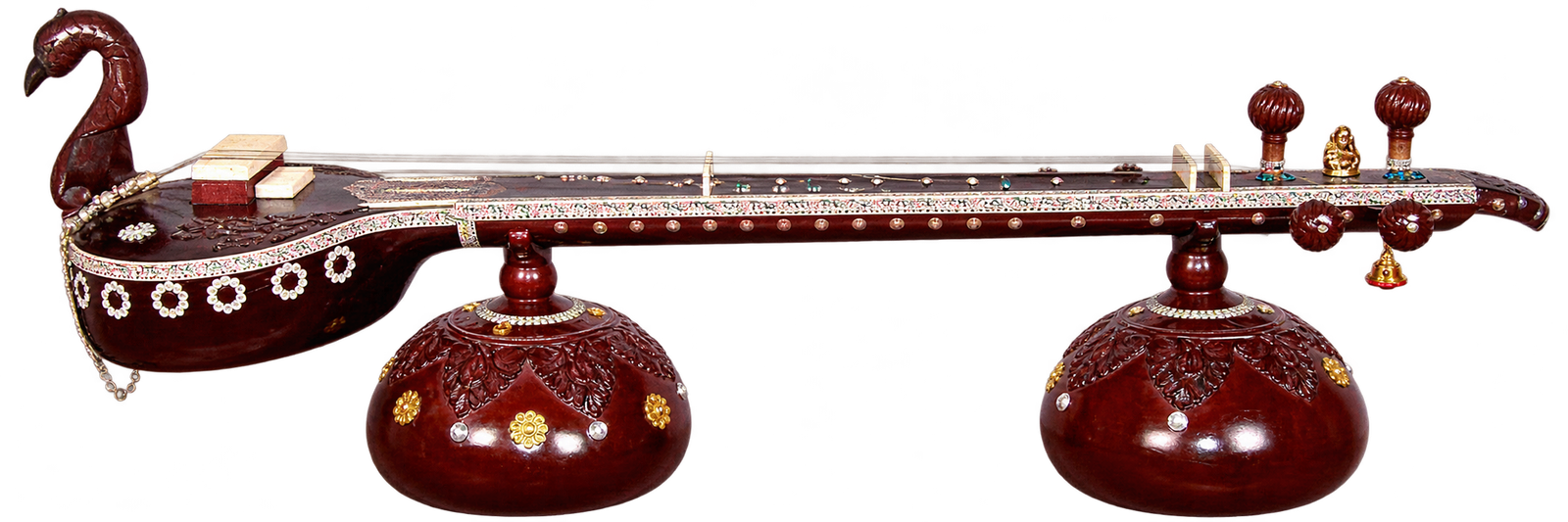
The extended dandi, large resonating tumbas, strings, tabli, and the moving contact of the gatta together form the distinctive body of the Vichitra Veena. These elements do not merely support sound; they carry, circulate, and extend it.
In Vichitra Veena performance, a sound does not simply arise through impact and then end. It travels, bends, turns, sustains, expands, and gradually dissolves into another tonal state. The instrument’s structure and its sonic character are therefore inseparable.
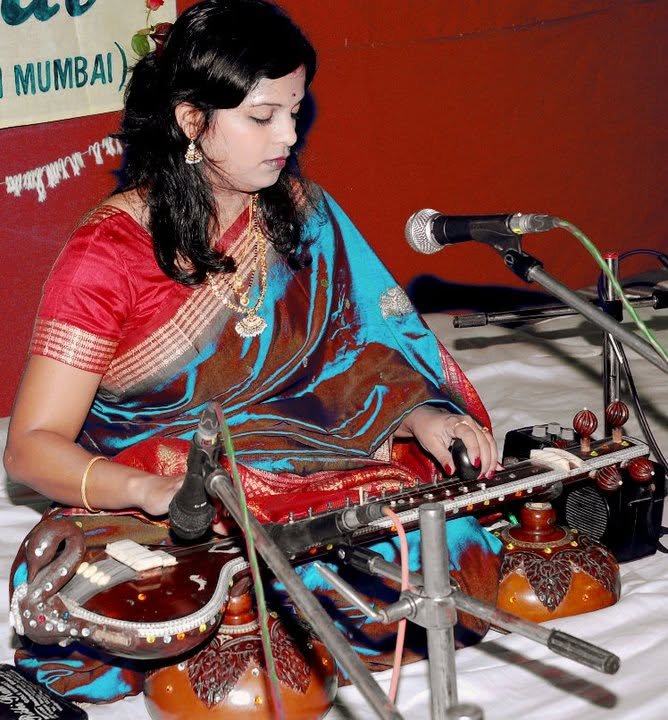
The Vichitra Veena is fretless. This fretless nature allows the performer to move continuously between swaras rather than passing through fixed, segmented positions. Through the movement of the gatta, the artist can reveal extremely subtle tonal intervals and the living gradations of shruti.
Its meend is not a sequence of separate points. It is an unbroken line of sound.
For this reason, mastery of the instrument requires more than technical control. It demands precision of the hand, steadiness of inner hearing, shruti-sensitivity, patience, concentration, and exceptional control over tonal movement. The Vichitra Veena is difficult to construct, maintain, tune, and master. Its rarity is therefore not merely statistical; it arises from the depth and continuity of discipline required from the performer.
A Living Field of Naad and Shruti
In Indian musical philosophy, Naad is not limited to audible sound. It is a principle of vibration, manifestation, expression, and consciousness. The Vichitra Veena offers a particularly powerful field in which Naad may be experienced in both its outward and inward dimensions.
Because the instrument has no frets, swara is not broken into rigid divisions. It remains continuous and capable of revealing the smallest movements of shruti. Across the mandra, madhya, and taar registers, the tonal flow retains its subtle life.
This makes the Vichitra Veena especially suited to the realization of shruti, not as an abstract theoretical interval, but as a living movement within sound.
Its tantri-naad may also move beyond ordinary external hearing. When the strings are touched softly, precisely, and continuously, the resonance may seem to descend from an inner acoustic space. It is heard outwardly and inwardly at the same time.
The instrument thus becomes not only a means of producing Naad, but also a means of entering its interior regions. Sound is no longer merely heard by the ear; it begins to act upon consciousness.
The Omkaric Architecture of the Vichitra Veena
The structure of the Vichitra Veena may also be interpreted in relation to Omkara. This connection is not limited to a superficial resemblance of shape. It extends to the instrument’s structure, movement of vibration, tonal journey, and inward process.
The two rounded tumbas provide its resonant foundation. The long fretless dandi carries vibration as a continuous path. The strings direct sound toward concentration and subtle expansion, while the tabli receives, holds, regulates, and distributes vibration.
Together, these elements create what may be called an Omkaric architecture.
The three matras of Om, A, U, and M, represent origination, expansion, and dissolution. A similar process unfolds within the sound of the Vichitra Veena. A tone arises, expands through shruti and meend, travels through emotional and tonal space, and finally gathers into laya.
Because the instrument is fretless, this movement remains especially clear. Sound does not stop abruptly at fixed positions. It travels, curves, refines, expands, and returns.
The relation also extends to bindu and ardha-chandra. Bindu may be understood as the concentrated point into which sound gathers, while ardha-chandra represents the subtle field that holds this concentration. The strings direct vibration toward such focus, while the tabli acts as its sustaining field.
The visible body of the Veena is murta, formed, tangible, and measurable. Its Naad is amurta, invisible and beyond physical grasp. The Vichitra Veena therefore stands at the meeting point of form and formlessness, body and resonance, sound and silence.
The visual diagram on page nine of the source study also presents this correspondence between the physical form of the Vichitra Veena and the structure of Omkara.
The Vichitra Veena as Yantra
In Indian traditions, a yantra is not merely a machine or geometric diagram. It is an organized structure that holds, regulates, concentrates, and directs force.
In this sense, the body of the Vichitra Veena is a living yantra.
Its tumbas, dandi, tabli, strings, and gatta are not isolated components. Together they form an organized geometry through which resonance and sonic energy are gathered and distributed.
When the practitioner sits before the instrument, the Veena gradually brings touch, sight, hearing, breath, and attention toward a single centre. Scattered mental energy begins to enter the discipline of swara.
The instrument therefore does not merely produce music. It shapes and steadies the inner field of the performer.
The external Veena and the human body may also be understood as corresponding sonic structures. The vibration created in the instrument interacts with the physical, mental, and subtle vibrations of the practitioner. The relation between performer and instrument becomes more than that of user and object; it becomes an interaction between two responsive fields of Naad.
The Vichitra Veena as Mantra
A mantra is not an accidental combination of sounds. It is an awakened sound-form made effective through correctness, repetition, concentration, and disciplined awareness.
The swaras and bols of the Vichitra Veena are similarly not random. Each must be rendered with precision, purity, timing, and inner attention. The performer must know which swara is to be produced, when it is to arise, and how it must unfold.
The repetition of a bol or tonal pattern is therefore not merely a technical exercise. Repetition acts upon the mind, body, attention, inner rhythm, and memory of the practitioner. Gradually, the sound becomes established within the chitta.
In this way, the Naad of the Vichitra Veena works in a mantra-like manner. It gathers the mind, regulates inner movement, deepens concentration, and guides awareness toward subtle listening.
The sound does not disappear when the audible vibration ends. It remains as swara-smriti, a tonal memory that continues to resonate within consciousness.
The Vichitra Veena may therefore be understood as mantra-svarupa, an embodiment of awakened, disciplined, and inwardly operative sound.
Vichitra Veena Practice as Tantra
In its deeper sense, tantra signifies expansion, protection, discipline, awakening, and transformation. It is not merely an external ritual category. It is a method through which force is awakened, organized, directed, and expanded through disciplined practice.
The practice of the Vichitra Veena brings the body, hand, breath, hearing, gaze, mind, patience, and silence into an ordered process.
Long meends, subtle shrutis, continuous tonal movement, and controlled contact require physical steadiness and sustained concentration. Restlessness, agitation, and scattered attention must gradually be transformed into tonal order.
For this reason, Vichitra Veena practice may be understood as a lived tantric process.
At deeper stages of performance, the distinction between player, instrument, and sound may begin to diminish. The performer no longer experiences herself merely as the one who is producing sound. She becomes part of the flowing field of swara.
Practice then moves beyond performance and becomes inward sadhana.
The Vichitra Veena gathers force, awakens it, expands it through the inner field of the practitioner, disciplines it, and may ultimately lead awareness beyond dependence upon external form. It does not merely stand beside tantra as a poetic analogy; it enacts tantric principles through musical practice.
Shri Vidya, Shiva-Shakti, and Audible Sacred Geometry
Within Shri Vidya, bindu, line, triangle, chakra, and mandalic enclosure express an ordered movement of sacred force. The Vichitra Veena presents a corresponding process through spanda, swara, meend, resonance, and embodied vibration.
It may therefore be understood as a shravy-yantra, an audible yantra through which sacred geometry becomes sound.
The silent centre of the Shri Chakra, the awakening of force from that centre, and the surrounding expansion of energy find a sonic correspondence in Veena performance: silence, contact with the string, the birth of swara, expansion through resonance, and eventual return to silence.
The Vichitra Veena may also be approached through the unity of Shiva and Shakti.
The silent ground and inward stillness correspond to Shiva-tattva. Awakened vibration, flowing swara, resonance, movement, and creative expression correspond to Shakti-tattva.
Within the sounding body of the Veena, stillness and vibration are not separated. They remain present in a living union.
The Vichitra Veena thus becomes a rare meeting point of sacred geometry, tantra, and yoga, a sonic path through which form, force, awareness, and silence are brought into one continuum.
The Distinctive Practice of Playing with a Narmadeshwar Shivling
The Vichitra Veena is conventionally played with a glass gatta or slide. Dr. Radhika Veenasadhika has, for many years, developed a distinctive practice of using a Narmadeshwar Shivling in place of the conventional glass slide.
Within this practice, the Shivling is not merely a technical object used to produce meend. It becomes a meeting point of Shiva-tattva, touch, friction, vibration, Naad, and sadhana.
This should not be presented as a general practice followed by all Vichitra Veena performers. It is a specific performance and spiritual practice associated with Dr. Radhika Veenasadhika and her followers.
More Than an Instrument: A Transformative Knowledge Tradition
The true identity of the Vichitra Veena lies not only in its antiquity or rarity, but in the completeness of its philosophical and practical system.
Its body is yantra, because it holds, organizes, and directs vibration and force.
Its Naad is mantra, because disciplined sound, repetition, precision, and concentration act upon the inner consciousness of the practitioner.
Its practice is tantra, because it brings the body, mind, breath, attention, and energy into a process of awakening and transformation.
This conceptual framework may also illuminate other Indian Veenas and related string instruments, with appropriate differences. Their bodies may be understood as structured fields of resonance; their swaras and bols may operate through repetition and vibrational effect; and their serious practice may involve restraint, embodied discipline, inward concentration, and transformation through sound.
The Vichitra Veena should therefore not be regarded merely as an ancient object to be preserved in museums or archives. It must be heard, taught, practiced, researched, and transmitted to future generations.
It is not only a heritage instrument from India’s past.
It is a living Indian knowledge tradition, a path through which sound guides the human being toward inner stillness, expanded awareness, and the deeper reality of Naad.