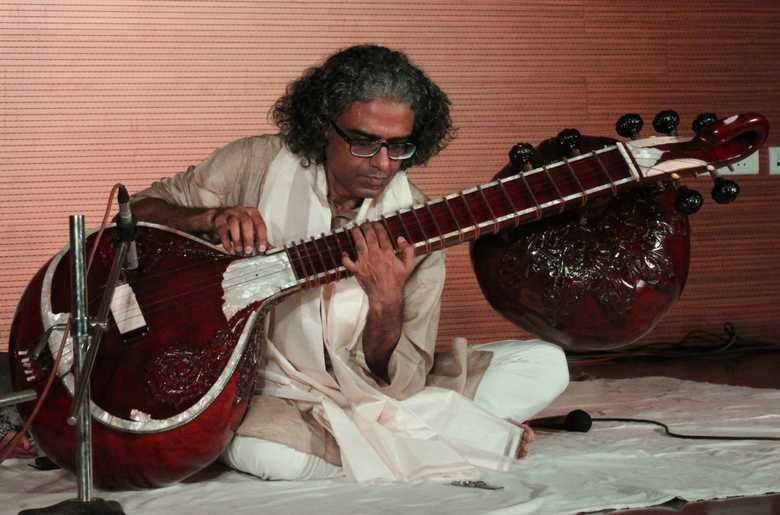
ध्रुपद वादन की आवश्यकताओं से विकसित एक नवीन वीणा
चन्द्रवीणा भारतीय तन्त्री-वाद्यों की आधुनिक परम्परा में विकसित एक विशिष्ट वाद्य है, जिसका निर्माण सरस्वती वीणा को ध्रुपद शैली की सांगीतिक आवश्यकताओं के अनुरूप रूपान्तरित करने के उद्देश्य से हुआ। इसकी परिकल्पना उस्ताद ज़ेड. एफ. डागर और उस्ताद बहाउद्दीन डागर के सुझाव से आरम्भ हुई, जिन्होंने सरस्वती वीणा पर ध्रुपद वादन की सम्भावनाओं का अन्वेषण करने के लिए प्रेरित किया।
चन्द्रवीणा के प्रवर्तक ने प्रारम्भिक वर्षों में सरस्वती वीणा का प्रशिक्षण प्राप्त किया था, किन्तु लगभग पन्द्रह वर्षों तक इस वाद्य से दूर रहकर सरोद और ध्रुपद का अध्ययन किया। डागर उस्तादों के सुझाव पर उन्होंने पुनः सरस्वती वीणा का अभ्यास आरम्भ किया और चेन्नई से एक पारम्परिक सरस्वती वीणा प्राप्त की। कुछ वर्षों के अभ्यास के बाद उन्होंने इस वाद्य पर ध्रुपद की प्रस्तुति के प्रयोग आरम्भ किए।
प्रारम्भिक प्रयोगों में सरस्वती वीणा की पीतल की सतह वाली मुख्य घुड़च के स्थान पर सींग का प्रयोग किया गया तथा ऊपरी सिरे पर एक अतिरिक्त अनुनादक जोड़ा गया। इन परिवर्तनों का उद्देश्य ध्रुपद की धीमी, विस्तृत स्वर-गतियों तथा स्वरों की सूक्ष्म विविधताओं के लिए वाद्य की क्षमताओं और सीमाओं को समझना था।
ध्रुपद शैली में दीर्घ स्वर-वाक्यों, सूक्ष्म स्वरान्तरों, गहन अनुनाद और ध्वनि की निरन्तरता की आवश्यकता को ध्यान में रखते हुए सरस्वती वीणा की मूल संरचना में छह प्रमुख परिवर्तन किए गए। लकड़ी के मुख्य अनुनादक के स्थान पर लौकी का तुम्बा लगाया गया और अधिक वायु-स्थान के लिए उसका आकार बढ़ाया गया। निम्न स्वर-क्षेत्र में बेहतर कम्पन प्राप्त करने के उद्देश्य से ध्वनिपटल का आकार भी बढ़ाया गया।
इसके अतिरिक्त तन्त्रियों की कम्पनशील लम्बाई बढ़ाई गई, जिससे स्वरों में सूक्ष्म परिवर्तन की अधिक सम्भावना उपलब्ध हो सके। ध्वनि को अधिक गम्भीर बनाने के लिए तन्त्रियों की मोटाई बढ़ाई गई तथा एक ही सारिका पर लम्बी स्वर-गतियों के लिए सारिकाओं की लम्बाई में भी वृद्धि की गई।
इस नवीन संरचना को साकार करने के लिए मैसूर, तंजावुर, त्रिची और कोलकाता के वाद्य-निर्माताओं से सम्पर्क किया गया। अन्ततः कोलकाता के वाद्य-निर्माता स्वर्गीय मोहनलाल शर्मा ने इसके प्रारम्भिक प्रतिरूप का निर्माण किया। उस्ताद ज़ेड. एफ. डागर और उस्ताद बहाउद्दीन डागर ने इस नवीन वाद्य को ‘चन्द्रवीणा’ नाम दिया।
मोहनलाल शर्मा के निधन के पश्चात् मिरज के पारम्परिक वाद्य-निर्माता माजिद सातारमेकर ने चन्द्रवीणा के निर्माण और ध्वनि-सम्बन्धी परिष्कार का कार्य आगे बढ़ाया। इसके अनुनाद और ध्वनि-गुणवत्ता में सुधार के प्रयोग निरन्तर जारी रहे हैं।
चन्द्रवीणा का महत्त्व सरस्वती वीणा की संरचना को ध्रुपद की विशिष्ट वादन-आवश्यकताओं के अनुरूप विकसित करने में निहित है। परिवर्तित अनुनादक, विस्तृत ध्वनिपटल, लम्बी कम्पनशील तन्त्रियाँ तथा बढ़ी हुई सारिकाएँ इसे एक अलग पहचान प्रदान करती हैं। यह वाद्य भारतीय शास्त्रीय संगीत में कलाकार की सांगीतिक आवश्यकताओं, ध्वनिविज्ञान की समझ और पारम्परिक वाद्य-निर्माण कौशल के समन्वय का उल्लेखनीय उदाहरण है।
प्रमुख स्रोत: Chandraveena.com — ‘Why Chandraveena?’; चन्द्रवीणा की परिकल्पना, संरचनात्मक विकास, निर्माण और ध्रुपद वादन सम्बन्धी प्रवर्तक का विवरण।
Chandraveena
A New Veena Developed for the Musical Demands of Dhrupad
The Chandraveena is a distinctive modern Indian stringed instrument developed by adapting the Saraswati Veena to the musical requirements of Dhrupad performance. Its conception began with a suggestion from Ustad Z. F. Dagar and Ustad Bahauddin Dagar, who encouraged the exploration of Dhrupad playing on the Saraswati Veena.
The instrument’s creator had received early training on the Saraswati Veena but had subsequently spent approximately fifteen years studying the sarod and the principles of Dhrupad without playing the Veena. Following the suggestion of the Dagar maestros, he resumed his practice, obtaining a traditional Saraswati Veena from Chennai. After several years of renewed study, he began experimenting with performing Dhrupad on the instrument.
His initial experiments included replacing the brass-topped main bridge with horn and adding an additional resonator at the upper end. These modifications were intended to explore the instrument’s capabilities and limitations in expressing the slow, extended melodic phrases and subtle tonal variations characteristic of Dhrupad.
As his understanding of the instrument and its acoustics developed, six principal structural changes were introduced. The original wooden resonator bowl was replaced with a gourd resonator, and its size was enlarged to provide a greater volume of air. The soundboard was also expanded to encourage stronger vibration, particularly in the lower-frequency register.
The vibrating length of the strings was increased to allow greater scope for subtle variations of notes. Thicker strings were introduced to produce greater tonal depth, while the length of the frets was extended to facilitate longer melodic phrases on a single fret. Together, these modifications were designed to enhance resonance, sustain and expressive flexibility.
To realise this new design, the creator approached instrument makers in Mysore, Thanjavur, Trichy and Kolkata. Eventually, the late Mohan Lal Sharma of Kolkata agreed to participate in the experiments and constructed the first prototype. The new instrument was subsequently named Chandraveena by Ustad Z. F. Dagar and Ustad Bahauddin Dagar.
Following Mohan Lal Sharma’s death, traditional instrument maker Majid Satarmaker of Miraj continued the work of constructing and refining the Chandraveena. Further experimentation with its acoustics and resonance has remained an ongoing aspect of its development.
The significance of the Chandraveena lies in its adaptation of the Saraswati Veena to the distinctive expressive demands of Dhrupad. Its modified resonator, enlarged soundboard, increased string length and extended frets give it a particular structural and tonal identity. The instrument represents an important example of the interaction between musical necessity, acoustic understanding and traditional craftsmanship in contemporary Indian classical music.
Principal source: Chandraveena.com, “Why Chandraveena?” — The creator’s account of the instrument’s conception, structural development, construction and adaptation for Dhrupad performance.