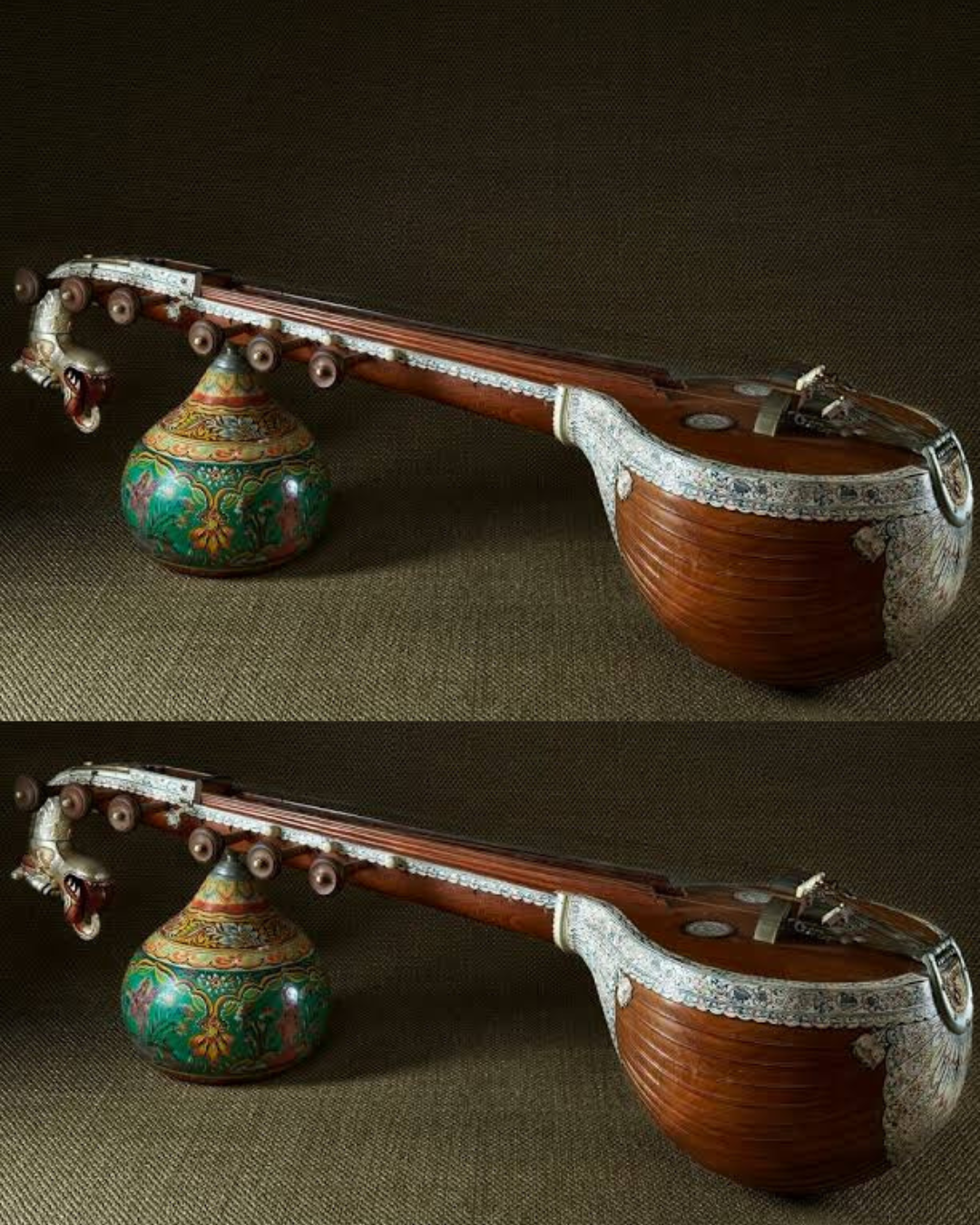
CHITRA VEENA
An Ancient Seven-Stringed Veena
Chitra Veena is one of the ancient Indian veenas whose name and musical importance have been preserved in textual sources, although its complete physical form cannot now be established with certainty. Seven tantris, finger-based playing, and the capacity for executing developed varnas and alamkaras are its principal textually attested features.
The first clear and technical description of this instrument under the name ‘Chitra’ occurs in Bharata’s Natyashastra. Earlier references to a seven-stringed veena are found in the Mahabharata, Pali Jataka literature, and the Guttila Jataka. G. H. Tarlekar, Swami Prajnanananda, and several other scholars associated these early seven-stringed veenas with Bharata’s Chitra Veena. This connection is plausible, but the complete identity of the terms ‘Saptatantri’ and ‘Chitra’ is not established through direct textual evidence.
Chitra in the Natyashastra
In his classification of daravi veenas—veenas constructed from wood—Bharata designated Vipanchi and Chitra as ‘anga’, while Kachchhapi, Ghoshaka, and related instruments were classified as ‘pratyanga’:
विपञ्ची चैव चित्रा च दारवीष्वङ्गसंज्ञिते।
कच्छपी घोषकादीनी प्रत्यङ्गानि तथैव च॥
Natyashastra, Chapter 33, verse 15
The number of tantris and the method of playing Chitra are clearly stated in the chapter on musical instruments:
सप्ततन्त्री भवेच्चित्रा विपञ्ची नवतन्त्रिका।
विपञ्ची कोणवाद्या स्याच्चित्रा चाङ्गुलिवादना॥
Natyashastra, Chapter 29, verse 118
Accordingly, Chitra had seven tantris, while Vipanchi had nine. Vipanchi was played with a kona—a nakhi or plectrum-like implement used to strike the strings—whereas Chitra was played with the fingers.
Chitra was not merely a simple instrument for producing isolated swaras. Bharata prescribed the performance of music incorporating guru and laghu syllables, dhatus, varnas, and alamkaras upon it:
धातुभिश्चित्रवीणाया गुरुलघ्वक्षरान्वितम्।
वर्णालंकारसंयुक्तं प्रयोक्तव्यं बुधैरिह॥
Natyashastra, Chapter 5, verse 42
This passage indicates that Chitra was capable of presenting organised musical structures, swara-patterns, and ornamental techniques. It would therefore be insufficient to interpret it simply as an instrument with seven strings, each producing only one separate open swara.
Matanga and the Tradition of Chitra Playing
In Nanyadeva’s Bharatabhashya, also known as Sarasvati Hridayalankara, Matanga—the author of Brihaddeshi—is identified as a player of Chitra Veena:
मतङ्गो वादकस्तस्याश्चैत्रिको नाम नापरः।
This statement presents Matanga not only as a musicologist but also as a practical performer of Chitra. Since the chapter on musical instruments in Brihaddeshi is no longer available, any description Matanga may have provided of the instrument’s construction or playing technique remains unknown.
Chitra is also mentioned in Sangeeta Makaranda, Sangeeta Sudha, and other later musicological works. Maharana Kumbha in Sangeetaraja, Shrikantha in Rasakaumudi, and texts such as Sangeeta Saramrita and Veena Prapathaka continued to recognise the tradition of its seven strings:
चित्रा सप्तभिरेव च।
Rasakaumudi, Chapter 2, verse 8
Sharngadeva’s Three Views on Its Playing Technique
In Sangeeta Ratnakara, Sharngadeva preserved three different views concerning the playing techniques of Chitra and Vipanchi. These accounts indicate that by the medieval period, no single method of playing Chitra remained universally accepted.
According to the first view, both Chitra and Vipanchi could be played with either the kona or the fingers:
कोणाङ्गुलिवादनीया चित्रा तद्वद्विपञ्चिका।
The second view prescribed finger-playing for Chitra and kona-playing for Vipanchi:
क्रमादन्येऽङ्गुलीकोणव्यवस्थामूचिरे तयोः।
According to the third view, Chitra was played only with the fingers, whereas Vipanchi could be played with either the fingers or a kona:
चित्रायामङ्गुलीमात्रं विपञ्च्यामुभयं परे।
Across these different views, Bharata’s original tradition of playing Chitra with the fingers remains its most consistent feature. The acceptance of kona-playing in one tradition, however, suggests that the instrument’s technique may have changed across different periods or regions.
The Unresolved Question of Tuning
Bharata, Nanyadeva, Someshvara, Parshvadeva, and Sharngadeva referred to the seven tantris of Chitra, but they did not explicitly state the swaras to which these strings were tuned. The instrument’s tuning system therefore remains one of the most difficult questions in any attempt at reconstruction.
One possibility is that the seven tantris were tuned to the seven swaras. Another interpretation proposes that when the grama or murchhana changed, the tuning of each tantri was adjusted according to the required intervallic arrangement. Sudhakara Bhatta suggested that a separate tuning prescription may have been considered unnecessary because tuning a limited number of strings according to a particular grama and murchhana was probably understood as part of contemporary musical practice.
It would therefore be conjectural to assume that Chitra’s seven tantris were tuned directly to the modern ascending sequence Sa, Re, Ga, Ma, Pa, Dha, and Ni.
A Swaramandala or a Dandi Veena?
Modern scholars have proposed two principal interpretations of Chitra’s physical form.
One view places it close to a Swaramandala or a smaller form of Mattakokila. This interpretation is based on its seven tantris and the use of the fingers for playing them. Sangeetasara mentions a seven-stringed Swaramandala in which metal strings were sounded with the fingers. The same textual tradition, however, also describes Mattakokila as having twenty-one strings. Therefore, the seven-stringed Swaramandala, Mattakokila, and Chitra cannot automatically be treated as identical instruments.
The second view interprets Chitra as a dandi veena from whose individual tantris more than one swara could be produced. Dr Lalmani Misra, Dr Premlata Sharma, and Dr Indrani Chakravarti were among the modern scholars who considered its possible form to have been structurally comparable to the sarod. According to this interpretation, the strings were not restricted to separate open swaras; their sounding length and pitch could also have been altered with the left hand.
The available texts do not provide detailed descriptions of Chitra’s danda, tumba, sarikas, bridge, string materials, or precise measurements. Neither of these proposed forms can therefore be regarded as its final and undisputed reconstruction.
Identification in Sculpture
Numerous stringed instruments are depicted in caves, stupas, and temples belonging to periods both before and after Bharata. Identifying Chitra among these sculptural representations is difficult because individual strings and tuning pegs are not always clearly rendered in stone. One or two pegs may be concealed on the unseen side of the instrument, and sculptors may at times have emphasised its general form instead of reproducing the precise number of structural components.
An instrument represented with five or six visible pegs cannot be identified as Chitra on that evidence alone. The following indicators must be considered together:
Evidence of several parallel tantris.
A right-hand position suggesting that the tantris were being played with the fingers.
The possibility that the left hand altered the sounding length of a tantri or produced different swara-sthanas.
A daravi, or wood-constructed, veena form.
Correspondence between the date of the sculpture and the available musicological evidence.
Structural differences from other contemporary instruments such as Vipanchi, Kinnari, and Ekatantri.
If a sculptural representation suggests that every tantri was played only as a separate open swara, the instrument may be closer to Vipanchi or another multi-stringed Swaramandala. If it shows the production of several swaras from a single tantri, its identification as Chitra becomes more plausible. Nevertheless, without an inscription, an accompanying name, or decisive structural evidence, such an identification must remain provisional.
The Proposed Relationship between Chitra, Rabab, and Sarod
Dr Lalmani Misra regarded Chitra as an ancient ancestor of the modern sarod. In the developmental hypothesis presented by him, the use of Chitra declined between approximately the seventh and thirteenth centuries under the growing influence of Kinnari and Ekatantri Veenas. Its transformed form subsequently emerged as the rabab during the medieval period and was eventually connected with the development of instruments such as the sursingar and sarod.
This interpretation is based on certain structural similarities among Chitra, rabab, and sarod: a dandi-type body, multiple strings, the possibility of producing variable pitches from the strings, and playing with either the fingers or a plectrum-like implement.
However, this proposed developmental line—from Chitra to rabab and then to sursingar and sarod—is not supported by a continuous sequence of surviving instruments or direct evidence documenting every intermediate stage. In a museum presentation, it should therefore be understood as an important modern scholarly hypothesis rather than an established historical fact.
Historical Significance
The importance of Chitra Veena extends far beyond the disappearance of its physical form. Its classification as an ‘anga’ veena in the Natyashastra, its definite number of seven tantris, its finger-based playing technique, its use for varnas and alamkaras, and its association with a musicologist and performer such as Matanga all assign it a distinguished position in the history of Indian stringed instruments.
The absence of detailed constructional descriptions in later texts may indicate that its practical use was gradually declining. Its memory nevertheless remained alive. It was variously associated with the ancient Saptatantri Veena, interpreted in relation to Swaramandala and Mattakokila, and regarded as a possible structural predecessor of the rabab and sarod.
Chitra Veena survives today not as a conclusively reconstructed instrument, but as a historical question situated between textual testimony, sculptural evidence, and musical tradition. Its most firmly established features are its seven tantris, finger-based playing, and capacity for developed musical expression. Its precise shape, tuning system, and genealogical relationship with later instruments remain subjects for further research and reconstruction.
Principal Textual Sources
Natyashastra, Chapter 29, verse 118—seven tantris and finger-based playing.
Natyashastra, Chapter 33, verse 15—classification of Chitra as an ‘anga’ among daravi veenas.
Natyashastra, Chapter 5, verse 42—performance incorporating dhatus, varnas, and alamkaras.
Nanyadeva’s Bharatabhashya, or Sarasvati Hridayalankara—Matanga’s identification as a player of Chitra.
Sangeeta Ratnakara, Vadyadhyaya, verses 111–112—three views concerning the playing techniques of Chitra and Vipanchi.
Maharana Kumbha’s Sangeetaraja—reference to the seven tantris of Chitra.
Rasakaumudi, Chapter 2, verse 8—the tradition of the seven-stringed Chitra.
Sangeetasara—descriptions relating to the seven-stringed Swaramandala and Mattakokila.
The Mahabharata and Pali Jataka literature—early references to the Saptatantri Veena.
Dr Lalmani Misra—discussion of the proposed developmental relationship among Chitra, rabab, sursingar, and sarod.
सात तन्त्रियों वाली प्राचीन वीणा
चित्रा वीणा भारतीय संगीत-इतिहास की उन प्राचीन वीणाओं में है जिनका नाम और संगीतगत महत्त्व ग्रन्थों में सुरक्षित है, किन्तु जिनका पूर्ण भौतिक स्वरूप आज निश्चित रूप से उपलब्ध नहीं है। सात तन्त्रियाँ, अंगुलियों से वादन और विकसित वर्ण-अलंकारों के प्रयोग की क्षमता इसकी प्रमुख ग्रन्थोक्त विशेषताएँ हैं।
‘चित्रा’ नाम से इस वीणा का पहला स्पष्ट और तकनीकी विवरण भरतमुनि के नाट्यशास्त्र में मिलता है। इससे पूर्व महाभारत, पालि जातक-साहित्य और गुत्तिल जातक में सप्ततन्त्री वीणा का उल्लेख प्राप्त होता है। जी. एच. तार्लेकर, स्वामी प्रज्ञानानन्द और कुछ अन्य विद्वानों ने इन प्राचीन सप्ततन्त्री वीणाओं को भरत की चित्रा वीणा से सम्बद्ध माना है। यह सम्बन्ध सम्भाव्य है, किन्तु ‘सप्ततन्त्री’ और ‘चित्रा’ नामों की पूर्ण समानता प्रत्यक्ष ग्रन्थीय प्रमाण से स्थापित नहीं होती।
नाट्यशास्त्र में चित्रा
भरत ने दारवी अर्थात् काष्ठ से निर्मित वीणाओं के वर्गीकरण में विपञ्ची और चित्रा को ‘अंग’ तथा कच्छपी और घोषक आदि को ‘प्रत्यंग’ कहा है:
विपञ्ची चैव चित्रा च दारवीष्वङ्गसंज्ञिते।
कच्छपी घोषकादीनी प्रत्यङ्गानि तथैव च॥
नाट्यशास्त्र, अध्याय ३३, श्लोक १५
चित्रा की तन्त्री-संख्या और वादन-विधि का स्पष्ट निर्देश नाट्यशास्त्र के वाद्याध्याय में मिलता है:
सप्ततन्त्री भवेच्चित्रा विपञ्ची नवतन्त्रिका।
विपञ्ची कोणवाद्या स्याच्चित्रा चाङ्गुलिवादना॥
नाट्यशास्त्र, अध्याय २९, श्लोक ११८
अर्थात् चित्रा में सात और विपञ्ची में नौ तन्त्रियाँ थीं। विपञ्ची को कोण—तार पर आघात करने वाले नखी अथवा वादक उपकरण—से तथा चित्रा को अंगुलियों से बजाया जाता था।
चित्रा केवल स्वर देने वाला सामान्य वाद्य नहीं थी। भरत ने उस पर गुरु और लघु अक्षरों, धातुओं, वर्णों तथा अलंकारों से युक्त संगीत के प्रयोग का निर्देश दिया है:
धातुभिश्चित्रवीणाया गुरुलघ्वक्षरान्वितम्।
वर्णालंकारसंयुक्तं प्रयोक्तव्यं बुधैरिह॥
नाट्यशास्त्र, अध्याय ५, श्लोक ४२
यह उल्लेख संकेत करता है कि चित्रा पर व्यवस्थित संगीत-विन्यास, स्वर-समूह और अलंकारिक क्रियाएँ प्रस्तुत की जा सकती थीं। अतः उसे केवल सात पृथक स्वरों वाला सरल वाद्य मानना पर्याप्त नहीं होगा।
मतंग और चित्रा-वादन की परम्परा
नान्यदेव के भरतभाष्य अथवा सरस्वतीहृदयालंकार में बृहद्देशी के रचयिता मतंग को चित्रा वीणा का वादक बताया गया है:
मतङ्गो वादकस्तस्याश्चैत्रिको नाम नापरः।
इस कथन के आधार पर मतंग की पहचान केवल संगीतशास्त्रकार के रूप में नहीं, बल्कि चित्रा के व्यावहारिक वादक के रूप में भी सामने आती है। बृहद्देशी का वाद्याध्याय वर्तमान में उपलब्ध न होने के कारण मतंग द्वारा चित्रा की संरचना अथवा वादन-पद्धति पर दिया गया सम्भावित विवरण ज्ञात नहीं है।
चित्रा का नाम संगीतमकरन्द, संगीतसुधा तथा अन्य परवर्ती संगीत-ग्रन्थों में भी मिलता है। महाराणा कुम्भ ने संगीतराज में, श्रीकण्ठ ने रसकौमुदी में और संगीतसारामृत तथा वीणाप्रपाठक जैसे ग्रन्थों ने भी इसकी सात तन्त्रियों की परम्परा को स्वीकार किया।
चित्रा सप्तभिरेव च।
रसकौमुदी, अध्याय २, श्लोक ८
शार्ङ्गदेव के तीन वादन-मत
शार्ङ्गदेव ने संगीतरत्नाकर में चित्रा और विपञ्ची की वादन-विधि के सम्बन्ध में प्रचलित तीन मत सुरक्षित किए हैं। इनसे ज्ञात होता है कि मध्यकाल तक चित्रा के वादन को लेकर एकमात्र सर्वमान्य परम्परा नहीं रह गई थी।
प्रथम मत के अनुसार चित्रा और विपञ्ची दोनों को कोण तथा अंगुली से बजाया जा सकता था:
कोणाङ्गुलिवादनीया चित्रा तद्वद्विपञ्चिका।
दूसरे मत में चित्रा के लिए अंगुली और विपञ्ची के लिए कोण का विधान है:
क्रमादन्येऽङ्गुलीकोणव्यवस्थामूचिरे तयोः।
तीसरे मत के अनुसार चित्रा केवल अंगुलियों से, जबकि विपञ्ची अंगुली अथवा कोण—दोनों से बजाई जा सकती थी:
चित्रायामङ्गुलीमात्रं विपञ्च्यामुभयं परे।
इन मतों में भरत की मूल परम्परा—चित्रा का अंगुली-वादन—सबसे स्थिर विशेषता के रूप में बनी रहती है। साथ ही कोण से वादन की स्वीकृति यह दर्शाती है कि विभिन्न कालों अथवा क्षेत्रों में इसकी वादन-पद्धति परिवर्तित भी हुई होगी।
स्वर-मेलन का अनुत्तरित प्रश्न
भरत, नान्यदेव, सोमेश्वर, पार्श्वदेव और शार्ङ्गदेव ने चित्रा की सात तन्त्रियों का उल्लेख किया, किन्तु उन्हें किन स्वरों में मिलाया जाता था, इसका स्पष्ट विधान नहीं दिया। इसी कारण चित्रा की पुनर्रचना का सबसे कठिन प्रश्न उसका स्वर-मेलन है।
एक सम्भावना यह है कि सातों तन्त्रियाँ सप्तस्वरों में मिलाई जाती रही हों। दूसरी व्याख्या के अनुसार ग्राम और मूर्छना बदलने पर प्रत्येक तन्त्री का स्वर भी आवश्यकतानुसार परिवर्तित किया जाता होगा। सुधाकर भट्ट ने स्वर-मेलन का पृथक निर्देश न मिलने का कारण यह माना कि सीमित तन्त्रियों को किसी विशेष ग्राम-मूर्छना के अन्तरालों के अनुसार मिलाना तत्कालीन संगीत-व्यवहार में स्वतः समझी जाने वाली प्रक्रिया रही होगी।
इसलिए चित्रा की सात तन्त्रियों को आधुनिक क्रम में सीधे ‘सा, रे, ग, म, प, ध, नि’ में मिला हुआ मानना केवल एक अनुमान होगा।
स्वरमण्डल अथवा दण्डी वीणा?
चित्रा के स्वरूप के सम्बन्ध में आधुनिक विद्वानों ने मुख्यतः दो प्रकार की परिकल्पनाएँ प्रस्तुत की हैं।
एक मत इसे स्वरमण्डल अथवा मत्तकोकिला के संक्षिप्त रूप के निकट रखता है। इस मत का आधार सात तन्त्रियाँ और अंगुलियों से उनका वादन है। संगीतसार में सात तारों वाले एक स्वरमण्डल का उल्लेख मिलता है, जिसमें धातु की तन्त्रियों को अंगुलियों से कम्पित करने का निर्देश दिया गया है। किन्तु उसी परम्परा में इक्कीस तन्त्रियों वाली मत्तकोकिला का भी वर्णन मिलता है। अतः सात-तन्त्री स्वरमण्डल, मत्तकोकिला और चित्रा को पूर्णतः एक ही वाद्य मानना सम्भव नहीं है।
दूसरे मत में चित्रा को ऐसी दण्डी वीणा माना गया है जिसमें प्रत्येक तन्त्री से एक से अधिक स्वर निकाले जा सकते थे। डॉ. लालमणि मिश्र, डॉ. प्रेमलता शर्मा और डॉ. इन्द्राणी चक्रवर्ती जैसे कुछ आधुनिक विद्वानों ने उसके सम्भावित स्वरूप को सरोद-सदृश माना। इस परिकल्पना में तन्त्रियों को केवल पृथक-पृथक खुले स्वर में बजाने के स्थान पर बाएँ हाथ की सहायता से उनका स्वर-परिवर्तन सम्भव माना गया है।
उपलब्ध ग्रन्थ चित्रा के दण्ड, तुम्ब, सारिका, घोड़ी, तन्त्री-सामग्री अथवा निश्चित माप का विस्तृत वर्णन नहीं देते। इसलिए इन दोनों में से किसी एक रूप को चित्रा का अन्तिम और निर्विवाद स्वरूप नहीं कहा जा सकता।
मूर्तिशिल्प में पहचान
भरत के पूर्व और परवर्ती काल की गुफाओं, स्तूपों तथा मन्दिरों में अनेक तन्त्री-वाद्य अंकित हैं। इन शिल्पों में चित्रा को पहचानना कठिन है, क्योंकि पत्थर पर सभी तन्त्रियाँ और खूँटियाँ स्पष्ट नहीं बन पातीं। कई बार एक-दो खूँटियाँ वाद्य के अदृश्य पार्श्व में हो सकती हैं और कभी कलाकार ने उनकी वास्तविक संख्या के स्थान पर वाद्य की सामान्य आकृति को महत्त्व दिया होगा।
किसी मूर्ति में पाँच अथवा छह खूँटियाँ दिखाई देने मात्र से उसे चित्रा नहीं कहा जा सकता। पहचान के लिए निम्न संकेतों को साथ देखना आवश्यक है:
१. वाद्य में अनेक समानान्तर तन्त्रियों का संकेत।
२. अंगुलियों से तन्त्रियों को छेड़ने वाली दक्षिण हस्त-मुद्रा।
३. बाएँ हाथ द्वारा तन्त्री की स्वर-लम्बाई बदलने अथवा स्वर-स्थान साधने की सम्भावना।
४. वाद्य का दारवी अर्थात् काष्ठनिर्मित वीणा-रूप।
५. मूर्ति के काल और उपलब्ध संगीतशास्त्रीय साक्ष्यों का परस्पर सामंजस्य।
६. उसी काल में प्रचलित विपञ्ची, किन्नरी और एकतन्त्री जैसे वाद्यों से उसकी संरचनात्मक भिन्नता।
यदि किसी शिल्प में प्रत्येक तन्त्री को केवल पृथक खुले स्वर के रूप में बजाने की व्यवस्था दिखाई देती है, तो वह विपञ्ची अथवा किसी बहुतन्त्री स्वरमण्डल के अधिक निकट भी हो सकता है। यदि एक ही तन्त्री से अनेक स्वर निकालने की क्रिया दिखाई दे, तो चित्रा की सम्भावना बढ़ती है। फिर भी अभिलेख, मूर्ति-नाम अथवा स्पष्ट संरचनात्मक प्रमाण के बिना ऐसी पहचान को सम्भावित ही माना जाना चाहिए।
चित्रा, रबाब और सरोद का प्रस्तावित सम्बन्ध
डॉ. लालमणि मिश्र ने चित्रा को आधुनिक सरोद की प्राचीन जननी माना। उनके द्वारा प्रस्तुत विकास-परिकल्पना में चित्रा का प्रचलन सातवीं से तेरहवीं शताब्दी के बीच किन्नरी और एकतन्त्री वीणाओं के प्रभाव से मन्द पड़ा। इसके पश्चात् उसका परिवर्तित रूप मध्यकाल में रबाब के रूप में सामने आया और आगे चलकर सुरसिंगार तथा सरोद जैसे वाद्यों के विकास से जुड़ा।
यह विचार चित्रा, रबाब और सरोद के बीच कुछ संरचनात्मक समानताओं—दण्डी शरीर, अनेक तन्त्रियाँ, तन्त्रियों से परिवर्तनीय स्वर और अंगुली अथवा कोण से वादन—पर आधारित है। किन्तु चित्रा से रबाब और फिर सरोद तक की यह विकास-रेखा निरन्तर भौतिक नमूनों अथवा प्रत्येक मध्यवर्ती चरण के प्रत्यक्ष प्रमाण से सिद्ध नहीं है। संग्रहालयीय प्रस्तुति में इसे स्थापित ऐतिहासिक तथ्य के स्थान पर एक महत्त्वपूर्ण आधुनिक विद्वत्-परिकल्पना के रूप में देखना उपयुक्त होगा।
ऐतिहासिक महत्त्व
चित्रा वीणा का महत्त्व उसके लुप्त भौतिक स्वरूप से कहीं अधिक व्यापक है। नाट्यशास्त्र में उसका ‘अंग’ वीणा के रूप में वर्गीकरण, सात तन्त्रियों की निश्चित संख्या, अंगुली-वादन, वर्ण-अलंकारों से युक्त प्रयोग और मतंग जैसे संगीताचार्य से उसका सम्बन्ध—ये सभी उसे भारतीय तन्त्री-वाद्य परम्परा में उच्च स्थान प्रदान करते हैं।
परवर्ती ग्रन्थों में इसके विस्तृत निर्माण-विवरण का अभाव सम्भवतः इसके घटते व्यावहारिक प्रचलन का संकेत है। फिर भी इसकी स्मृति लगातार बनी रही। कभी उसे प्राचीन सप्ततन्त्री वीणा से जोड़ा गया, कभी स्वरमण्डल और मत्तकोकिला के निकट समझा गया और कभी रबाब तथा सरोद की पूर्ववर्ती संरचनात्मक कड़ी के रूप में देखा गया।
आज चित्रा वीणा हमारे सामने किसी पूर्णतः पुनर्निर्मित वाद्य के रूप में नहीं, बल्कि पाठ, शिल्प और संगीत-परम्परा के बीच स्थित एक ऐतिहासिक प्रश्न के रूप में उपस्थित होती है। उसके विषय में सर्वाधिक निश्चित तथ्य हैं—सात तन्त्रियाँ, अंगुली-प्रधान वादन और विकसित संगीत प्रस्तुत करने की क्षमता। उसका वास्तविक आकार, स्वर-मेलन और बाद के वाद्यों से वंशगत सम्बन्ध अभी भी शोध और पुनर्रचना के विषय हैं।
प्रमुख पाठाधार
१. नाट्यशास्त्र, अध्याय २९, श्लोक ११८—सात तन्त्रियाँ और अंगुली-वादन।
२. नाट्यशास्त्र, अध्याय ३३, श्लोक १५—दारवी वीणाओं में चित्रा का ‘अंग’ रूप।
३. नाट्यशास्त्र, अध्याय ५, श्लोक ४२—धातु, वर्ण और अलंकारों से युक्त प्रयोग।
४. नान्यदेव, भरतभाष्य अथवा सरस्वतीहृदयालंकार—मतंग का चित्रा-वादक के रूप में उल्लेख।
५. संगीतरत्नाकर, वाद्याध्याय, श्लोक १११–११२—चित्रा और विपञ्ची की वादन-विधियों के तीन मत।
६. संगीतराज, महाराणा कुम्भ—चित्रा की सात तन्त्रियों का उल्लेख।
७. रसकौमुदी, अध्याय २, श्लोक ८—सप्ततन्त्री चित्रा की परम्परा।
८. संगीतसार, सात-तन्त्री स्वरमण्डल और मत्तकोकिला सम्बन्धी विवरण।
९. महाभारत तथा पालि जातक-साहित्य—सप्ततन्त्री वीणा के प्राचीन उल्लेख।
१०. डॉ. लालमणि मिश्र, चित्रा, रबाब, सुरसिंगार और सरोद के प्रस्तावित विकास-सम्बन्ध का विवेचन।