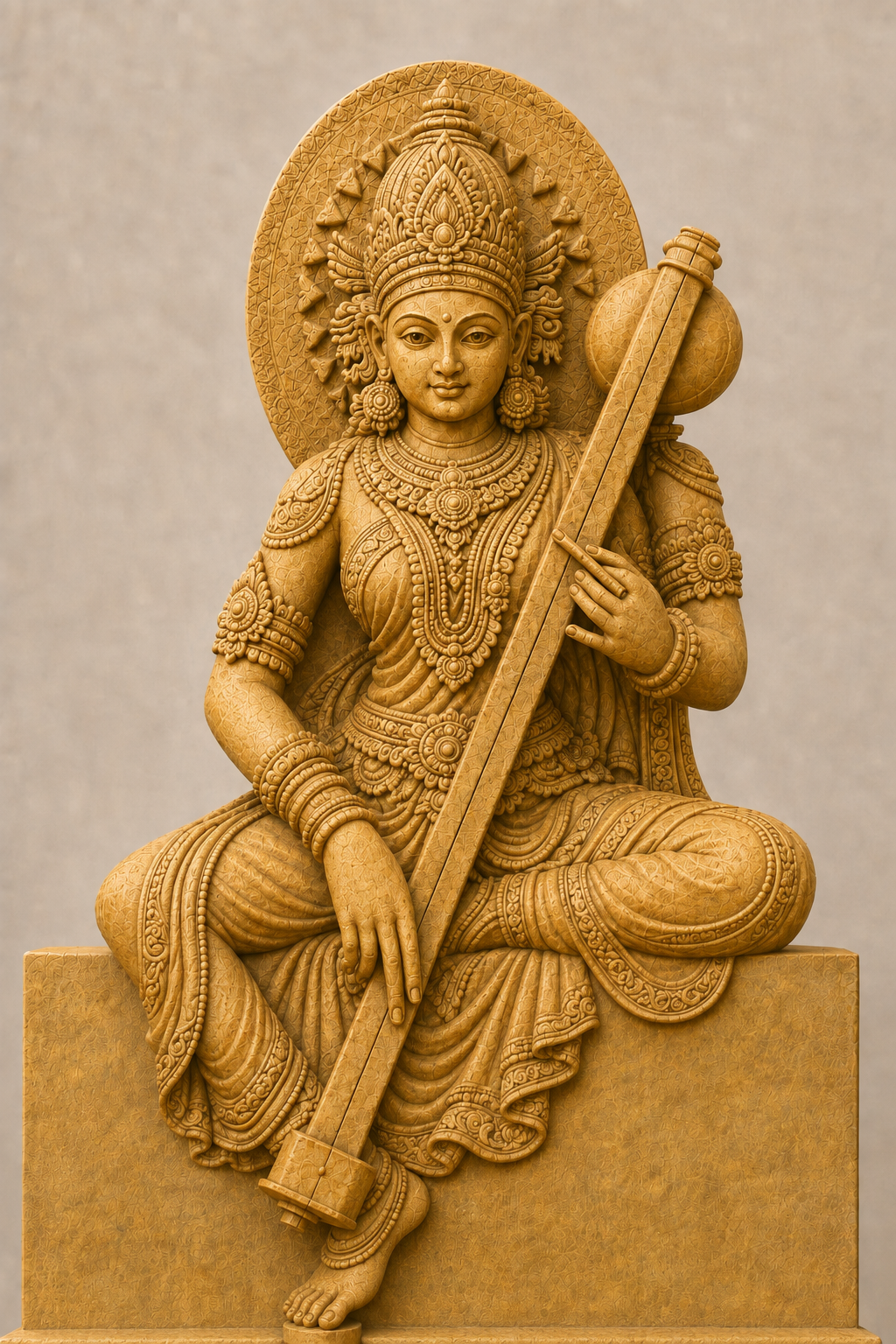
EKTANTRI VEENA
Ektantri Veena is an ancient and fundamental instrument of the Indian Tantri-vadya tradition. Here, ‘Ektantri’ refers to a specific Veena in which different swaras were produced on a single tantri. Within the broader classification of musical instruments, the term ‘Ektantuk’ may also refer to instruments that have more than one supporting string, while the different swaras of the saptak are played on a single principal string. Its primary distinguishing feature is the absence of separate strings for individual swaras. Different swaras are produced by changing the active length or tension of the string with a finger, shalaka, or another implement. A significant advantage of producing successive swaras on Ektantri is the continuity of Naad, as no interval devoid of Naad occurs between two swaras.
Names and Textual Tradition
Several names associated with Ektantri Veena are found in later texts, including Ghosha, Ghoshak, Ghoshika, Ghoshavati, and Brahma Veena. Bharata Muni mentioned ‘Ghoshak’ under the category of Pratyanga instruments, but did not provide a detailed description of its form. In the classification of Veenas presented by Abhinavagupta, sarika-free Veenas with a tumba are mentioned under the Alabu category. Alabu means veena has minimum one tumba. Pinjanaka and Nakula were placed within this category, and Pinjanaka was regarded as a synonym for ‘Ghosha’. Later acharyas were not in complete agreement regarding this naming tradition. In Sangeeta Makaranda, Narada mentioned Ghoshavati and Ghoshika as separate names, but did not mention Ektantri. Sudhakalasha referred to Ghoshavati and Brahmi Veena in Sangeetopanishatsaroddhara, but did not mention Ghosha. Kumbha referred to Ektantri as Ghoshak. Both Ghosha and Ghoshavati are mentioned in Sangeeta Narayana and Vadya Prakasha.
In Sangeeta Ratnakara, Sharngadeva provided a systematic description of Ektantri and also gave Pinjaraka and Ghoshak as its names:
एषा पिञ्जरका प्रोक्ता घोषकश्चैकतन्त्रिका ॥ ६.१०७ ॥
Brahmi Veena, Ghosha, Ghoshak, Ghoshavati, and Ektantri have been associated with the same instrumental tradition in several later descriptions. However, not all granthakaras used these names with the same meaning. It is possible that names such as Ektantri, Ghosha, Ghoshika, and Ghoshavati were used according to the number of strings, while their fundamental instrumental basis remained connected with the same tradition. Sharngadeva described Ektantri as the mother of all Veenas:
यत्राभिदधिरे धीरास्तां वीणामेकतन्त्रिकाम् ।
प्रकृतिः सर्ववीणानामेषा श्रीशार्ङ्गिणोदिता ॥ ६.५३ ॥
Structure and Principal Components
A detailed description of Ektantri Veena is found in Sangeeta Ratnakara. Its danda was required to be smooth, round, straight, and free from knots, wounds, cracks, and other defects. The original text specifies Khadira wood for its construction. The length of the danda was three hasta, equivalent to seventy-two angula or approximately fifty-four inches. Its circumference was one vitasti, or approximately nine inches. The danda was hollow from within, and the circumference of its internal opening was one and a half angula.
An alabu, or gourd, was fastened at a distance of seventeen angula from one end of the danda. Its circumference was sixty angula, and its opening measured twelve angula. The kakubha was located at the other end of the danda. A metal patrika, raised like the back of a kurma, was placed over the kakubha. A doraka was tied above the gourd and included a Nagapasha arrangement. The tantri, made from taant or snayu, was tied to the Nagapasha, passed over the patrika of the kakubha, and firmly secured to a shanku or tuning peg.
A bamboo jiva was placed between the tantri and the patrika for Naad-siddhi. This Veena had no sarikas. A bamboo kamrika was used for producing swaras. It was held with the support of the little, ring, and middle fingers of the left hand and moved up and down along the tantri. This action was known as Sarana.
During performance, the tantri was positioned upward and the gourd downward. The dorika-desha was placed on the left shoulder, while the kakubha rested on the heel of the right foot. With the right hand, the tantri was struck or plucked at a distance of one vitasti from the jiva, while the left hand performed swara-sarana with the kamrika.
Swara Production and Playing Technique
In Haripala’s Sangeeta Sudhakara, a bamboo shalaka measuring twelve angula in length is mentioned as the implement used for producing swaras on Ektantri. It was held between the fingers of the left hand and used to apply pressure on the string, allowing all swaras to be played:
शलाकां वेणुनिर्वृत्तां द्वादशाङ्गुल्याधिकम् ।
संवेष्ट्यानामिकाङ्गुल्या तर्जन्यङ्गुष्ठकस्ततः ।
संपीड्य गाढमनया वादयेदखिलान् स्वरान् ॥
Sangeeta Sudhakara, Haripala, manuscript text
In Sangeeta Ratnakara, this swara-producing implement is called the ‘kamrika’. The Veena was held so that the tumba and the face of the Veena remained downward, while the tantri remained upward. The dorika was placed on the left shoulder, and the kakubha was carefully supported on the heel of the right foot. The kamrika was placed on the back of the little finger of the left hand and encircled with the ring finger. The middle finger was slightly bent and brought towards the tip of the index finger while pressing the tantri. The kamrika was moved up and down along the tantri to perform swara-sarana. With the right hand, the tantri was played through tadana or chhedana at a distance of one vitasti from the jiva.
The action of the kamrika was called ‘Sarana’. Sharngadeva described four types of Sarana: Utkshipta, Sannivishta, Ubhayi, and Kampita. Subtle swara-bhedas could be produced by moving the kamrika up and down and by increasing or decreasing its pressure on the tantri. In this playing technique, the right hand performed the tadana of the tantri, while the left hand produced mandra, madhya, and taar swaras through Sarana.
Shruti, Murchhana, and Continuity of Naad
In Nanyadeva’s Bharatabhashya, Ektantri is described as the foundation of all shrutis, swaras, murchhanas, and various taans:
श्रुतयोऽथ स्वरा मूर्च्छाताना नानाविधास्तथा ।
एकतन्त्रीकवीणायां सर्वमेतत्प्रतिष्ठितम् ॥
Bharatabhashya, Nanyadeva, manuscript text
In the absence of sarikas, the tantri was not divided into fixed swara positions. Therefore, grama, murchhana, swara, and subtle shruti intervals could be presented by changing the position and pressure of the kamrika on the tantri. Nanyadeva expressed the possibility of producing even the most subtle shrutis on this instrument and described it as the abode of Saraswati. Since the movement of swaras took place on a single tantri, continuity of Naad was maintained. A highly refined form of this principle of Tantri-Sarana can be seen in the later playing traditions of Vichitra Veena and Gottuvadyam. B. Chaitanya Deva regarded Ektantri as a neckless form of instrument and noted that its depictions are available in several ancient sculptures. Forms of this type of Veena have also been noted in numerous temple sculptures created between the seventh and fifteenth centuries.
Sarvadevamayi Veena
Sharngadeva regarded Ektantri not merely as an instrument for producing music, but as a Sarvadevamayi and Sarvamangalamayi Veena. Its darshan and sparsh were said to bestow bhoga, svarga, and apavarga, and to purify a person from sins:
दर्शनस्पर्शने चास्या भोगस्वर्गापवर्गदे ।
पुनीतो विप्रहत्यादिपातकैः पतितं जनम् ॥ ६.५४ ॥
The symbolic presence of deities within its different components was described as follows:
दण्डः शंभुरुमा तन्त्री ककुभः कमलापतिः ।
इन्दिरा पत्रिका ब्रह्मा तुम्बं नाभिः सरस्वती ॥
दोरको वासुकिर्जीवा सुधांशुर्दोरिका रविः ।
सर्वदेवमयी तस्माद्वीणेयं सर्वमङ्गला ॥ ६.५५–५६ ॥
Within this symbolic scheme, the danda represents Shiva, the tantri represents Uma, the kakubha represents Vishnu, the patrika represents Lakshmi, the tumba represents Brahma, its nabhi represents Saraswati, the doraka represents Vasuki, the jiva represents the Moon, and the dorika represents the Sun. An important textual clarification is necessary here. In the available Vadyadhyaya text of Sangeeta Ratnakara, the reading is “dorika ravih”, meaning that the dorika represents the Sun. Some later quotations use “sarika ravih” in its place. Since sarikas are absent from the original structural description of Ektantri, Sharngadeva’s use of ‘dorika’ is consistent with its sarika-free form.
Principal textual sources: Sharngadeva, Sangeeta Ratnakara, Vadyadhyaya, verses 28–107; Haripala, Sangeeta Sudhakara, manuscript text; Nanyadeva, Bharatabhashya/Saraswati-Hridayalankara, manuscript tradition.
एकतन्त्री वीणा
एकतन्त्री वीणा भारतीय तन्त्रीवाद्य-परम्परा की एक प्राचीन और मूलभूत वीणा है। यहाँ ‘एकतन्त्री’ का अभिप्राय उस विशिष्ट वीणा से है जिसमें एक ही तन्त्री पर विभिन्न स्वर उत्पन्न किए जाते थे। व्यापक वाद्य-वर्गीकरण में ‘एकतंतुक’ उन वाद्यों को भी कहा जा सकता है जिनमें सहायक तार एक से अधिक हों, किन्तु सप्तक के विभिन्न स्वर एक ही मुख्य तार पर बजाए जाते हों। प्रत्येक स्वर के लिए अलग-अलग तार का न होना इसका प्रमुख व्यवच्छेदक लक्षण है। तार की क्रियाशील लम्बाई अथवा उसके तनाव को उँगली, शलाका या अन्य साधन द्वारा बदलकर विभिन्न स्वर उत्पन्न किए जाते हैं। एक ही तन्त्री पर स्वरों के क्रमिक निष्पादन का विशेष लाभ नाद-सातत्य है, क्योंकि दो स्वरों के मध्य नादरहित अन्तर उत्पन्न नहीं होता।
नाम और ग्रन्थ-परम्परा
एकतन्त्री वीणा के कई अन्य नाम भी थे, जिनमें घोषा, घोषक, घोषिका, घोषवती और ब्रह्मवीणा आदि सम्मिलित हैं। भरतमुनि ने ‘घोषक’ का उल्लेख प्रत्यंग वाद्यों के अन्तर्गत किया है, किन्तु उसका विस्तृत स्वरूप नहीं बताया। अभिनवगुप्त द्वारा प्रस्तुत वीणा-वर्गीकरण में अलाबु-वर्ग के अन्तर्गत सारिका-रहित और तुम्ब-युक्त वीणाओं का उल्लेख मिलता है। इसी वर्ग में पिञ्जानका और नकुला को रखा गया तथा पिञ्जानका को ‘घोषा’ का पर्याय माना गया। परवर्ती आचार्यों में इस नाम-परम्परा को लेकर पूर्ण एकमत नहीं है। संगीतमकरन्द में नारद ने घोषावती और घोषिका को अलग-अलग नामों से उल्लिखित किया, जबकि एकतन्त्री का नाम नहीं दिया। सुधाकलश ने संगीतोपनिषद्सारोद्धार में घोषावती और ब्रह्मी वीणा का उल्लेख किया, किन्तु घोषा का नहीं। कुम्भ ने एकतन्त्री को घोषक कहा। संगीतनारायण और वाद्यप्रकाश में घोषा तथा घोषावती दोनों नाम मिलते हैं।
शार्ङ्गदेव ने संगीतरत्नाकर में एकतन्त्री का व्यवस्थित वर्णन करते हुए उसके पिञ्जरका और घोषक नाम भी दिए हैं:
एषा पिञ्जरका प्रोक्ता घोषकश्चैकतन्त्रिका ॥ ६.१०७ ॥
ब्रह्मी वीणा, घोषा, घोषक, घोषवती और एकतन्त्री को अनेक परवर्ती विवरणों में एक ही वाद्य-परम्परा से सम्बद्ध किया गया है, किन्तु सभी ग्रन्थकार इन नामों का समान अर्थ में प्रयोग नहीं करते। सम्भवतः तारों की संख्या के अनुसार एकतन्त्री, घोषा, घोषिका और घोषवती आदि में भेद किया जाता रहा हो, किन्तु मूल वाद्य और आधार एक ही था। शार्ङ्गदेव ने एकतन्त्री को सर्ववीणाओं की जननी कहा है:
यत्राभिदधिरे धीरास्तां वीणामेकतन्त्रिकाम् ।
प्रकृतिः सर्ववीणानामेषा श्रीशार्ङ्गिणोदिता ॥ ६.५३ ॥
संरचना और प्रमुख अंग
एक तन्त्री का वर्णन ‘संगीतरत्नाकर’ में अच्छी तरह किया गया है। वीणा के दण्ड की लंबाई तीन हस्त अर्थात् ७२ अंगुल (५४ इंच) होती थी। दण्ड की परिधि या घेरे का नाप एक वितस्ति या बित्ता (९ इंच) होता था। दण्ड का छिद्र पूरी लंबाई में १३ अंगुल (१टै इंच) व्यास का रहता था। एक सिरे से १७ अंगुल की दूरी पर अलाबु या कद्द को बाँधना होता था। दण्ड आबनूस की लकड़ी से बनाय। जाता था। कद्द का व्यास ६० अंगुल (४५ इंच) होता था। दूसरे सिरे में ककुभ रहता था। ककुभ के ऊपर धातु से बनायी हुई कूर्म पृष्ठ की भाँति पत्रिका होती थी । कद्द के ऊपर नागपाश पहित रस्सी बाँधी जाती थी। ताँत अर्थात् स्नायु की तन्त्री को नागपाश में बाँधकर ककुभ के ऊपर की पत्रिका के ऊपर लाकर शंकु या खूंटो से बाँधा जाता था। तन्त्री और पत्रिका के बीच में नाद सिद्धि के लिए वेणु निर्मित ‘जीवा’ रखते थे। इस वीणा में सारिकाएं नहीं हैं। बायें हाथ के अंगूठा, कनिष्ठिका और मध्यमा पर वेणुनिर्मित कम्रिका को धारण कर तर्जनी से आघात करके सारण किया जाता था। तन्त्री को ऊर्ध्वमुख करके तथा कद्दू को अधोमुखः करके, ककुभ को दाहिने पाँव पर रखकर, कद्द को कंधे के ऊपर रहने की स्थिति में रखकर, जीवा से एक बित्ता की दूरी पर उँगली से वादन किया जाता था ।
स्वर-साधन और वादन-विधि
हरिपाल के संगीतसुधाकर में एकतन्त्री के स्वर-साधन के लिए बाँस की बारह अंगुल लम्बी शलाका का उल्लेख है। उसे बाएँ हाथ की उँगलियों में धारण करके तार पर दबाव डालते हुए समस्त स्वर बजाए जाते थे:
शलाकां वेणुनिर्वृत्तां द्वादशाङ्गुल्याधिकम् ।
संवेष्ट्यानामिकाङ्गुल्या तर्जन्यङ्गुष्ठकस्ततः ।
संपीड्य गाढमनया वादयेदखिलान् स्वरान् ॥
संगीतसुधाकर, हरिपाल, पाण्डुलिपि-पाठ
संगीतरत्नाकर में इसी स्वर-साधक उपकरण को ‘कम्रिका’ कहा गया है। वीणा को इस प्रकार धारण किया जाता था कि दोनों तुम्बा तथा वीणा का मुख नीचे की ओर रहे और ऊपर को तार रहे। इस प्रकार के मोड़ के स्थान को बायें कन्धे पर रखा जाता था और ककुभ को दाहिने पैर की एड़ी पर सावधानी से टिकाया जाता था। कम्रिका को बाएँ हाथ की कनिष्ठा के पृष्ठ पर रखकर अनामिका से आवेष्टित किया जाता था। मध्यमा को कुछ मोड़कर तर्जनी के अग्रभाग से मिलाते हुए तन्त्री को दबाया जाता था। कम्रिका को तन्त्री पर ऊपर-नीचे चलाकर स्वर-सारण की जाती थी। दाहिने हाथ से जीवा से एक वितस्ति की दूरी छोड़कर तन्त्री का ताड़न अथवा छेदन किया जाता था।
कम्रिका की क्रिया को ‘सारणा’ कहा गया है। शार्ङ्गदेव ने सारणा के चार प्रकार बताए हैं: उत्क्षिप्ता, संनिविष्टा, उभयी और कम्पिता। कम्रिका को ऊपर-नीचे चलाने तथा तन्त्री पर उसके दबाव को कम-अधिक करने से सूक्ष्म स्वरभेद उत्पन्न किए जा सकते थे। इस वादन-प्रणाली में दाहिना हाथ तन्त्री का ताड़न करता था और बायाँ हाथ सारण द्वारा मन्द्र, मध्य तथा तार स्वरों की सिद्धि करता था।
श्रुति, मूर्छना और नाद-सातत्य
नान्यदेव के भरतभाष्य में एकतन्त्री को समस्त श्रुतियों, स्वरों, मूर्छनाओं और विविध तानों का आश्रय कहा गया है:
श्रुतयोऽथ स्वरा मूर्च्छाताना नानाविधास्तथा ।
एकतन्त्रीकवीणायां सर्वमेतत्प्रतिष्ठितम् ॥
भरतभाष्य, नान्यदेव, पाण्डुलिपि-पाठ
सारिकाओं के अभाव में तन्त्री निश्चित स्वरस्थानों में विभाजित नहीं थी। अतः तन्त्री पर कम्रिका की स्थिति और दबाव बदलकर ग्राम, मूर्छना, स्वर और सूक्ष्म श्रुति-अन्तर प्रस्तुत किए जा सकते थे। नान्यदेव ने इस वाद्य पर सूक्ष्मतम श्रुतियों के निष्पादन की सम्भावना व्यक्त की और इसे सरस्वती का निवास कहा। एक ही तन्त्री पर स्वर-संचालन के कारण इसमें नाद-सातत्य बना रहता था। इसी तन्त्री-सारण सिद्धान्त का अत्यन्त परिष्कृत रूप बाद की विचित्र वीणा और गोट्टवाद्यम् जैसी वादन-पद्धतियों में देखा गया है। बी. चैतन्य देव ने एकतन्त्री को ग्रीवाविहीन वाद्यरूप माना है और उसके चित्रण अनेक प्राचीन शिल्पों में उपलब्ध बताए हैं। सातवीं से पन्द्रहवीं शताब्दी के मध्य निर्मित अनेक मन्दिर-शिल्पों में भी इस प्रकार की वीणा के रूपों का उल्लेख किया गया है।
सर्वदेवमयी वीणा
शार्ङ्गदेव ने एकतन्त्री को केवल संगीत-निर्माण का साधन नहीं, बल्कि सर्वदेवमयी और सर्वमंगलमयी वीणा माना। उसके दर्शन और स्पर्श को भोग, स्वर्ग और अपवर्ग प्रदान करने वाला तथा पापों से शुद्ध करने वाला कहा गया:
दर्शनस्पर्शने चास्या भोगस्वर्गापवर्गदे
पुनीतो विप्रहत्यादिपातकैः पतितं जनम् ॥ ५४ ॥
दण्डः शंभुरुमा तन्त्री ककुघः कमलापतिः
इन्दिरा पत्रिका ब्रह्मा तुम्बं नाभिः सरस्वती ॥ ५५ ॥
दोरको वासुकिर्जीवा सुधांशुर्दोरिका रविः
सर्वदेवमयी तस्माद्वीणेयं सर्वमङ्गला ॥ ५६ ॥
इस प्रतीक-योजना में दण्ड शिव, तन्त्री उमा, ककुभ विष्णु, पत्रिका लक्ष्मी, तुम्ब ब्रह्मा, उसकी नाभि सरस्वती, दोरक वासुकि, जीवा चन्द्र और दोरिका सूर्य का रूप है। यहाँ एक महत्त्वपूर्ण पाठ-स्पष्टता आवश्यक है: संगीतरत्नाकर के उपलब्ध वाद्याध्याय-पाठ में “दोरिका रविः” है, अर्थात् दोरिका सूर्यरूप है। कुछ परवर्ती उद्धरणों में इसके स्थान पर “सारिका रविः” मिलता है। एकतन्त्री के मूल संरचनात्मक वर्णन में सारिकाओं का अभाव है, इसलिए शार्ङ्गदेव के पाठ में ‘दोरिका’ का उल्लेख उसके सारिका-रहित स्वरूप के साथ संगत है।
प्रमुख पाठाधार: शार्ङ्गदेव, संगीतरत्नाकर, वाद्याध्याय, श्लोक २८–१०७; हरिपाल, संगीतसुधाकर, पाण्डुलिपि-पाठ; नान्यदेव, भरतभाष्य/सरस्वती-हृदयालंकार, पाण्डुलिपि-परम्परा।